Scalable Data Infrastructure & Consistency Models

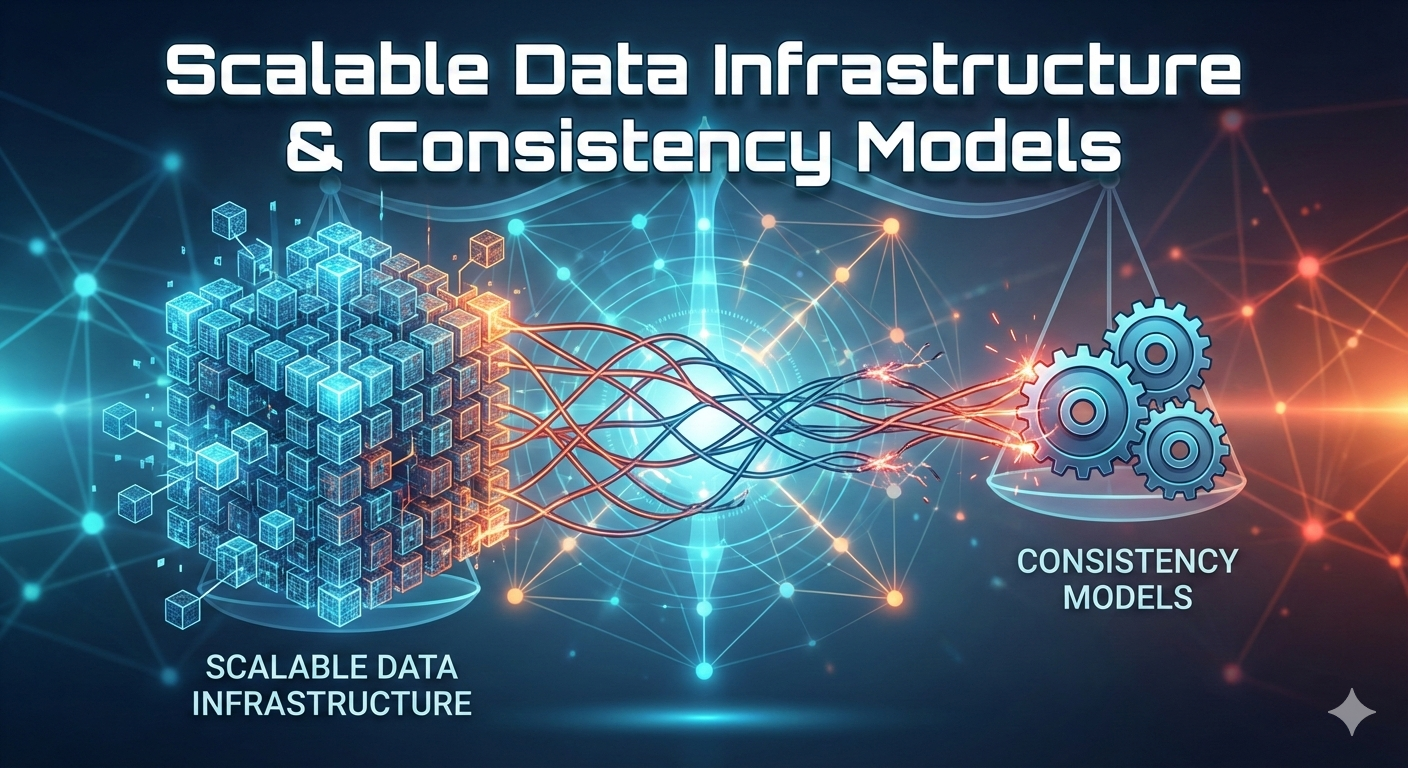
Most systems begin their lives with an implicit assumption: data is consistent because the database makes it so. Early architectures rely on defaults—single instances, synchronous writes, transactional guarantees—without consciously choosing a consistency model. At small scale, this works. At larger scale, it quietly fails.
As systems grow, data volume and traffic increase linearly or even exponentially. Teams add capacity, scale out infrastructure, and introduce replicas. Throughput improves. Storage grows cheaply. And yet, latency spikes, anomalies appear, and correctness becomes harder to reason about. The bottleneck is no longer compute or disk. It is coordination.
Consistency stops scaling at the same rate as data and traffic because consistency is fundamentally about agreement. Agreement requires coordination, and coordination is constrained by latency, failure, and contention. While storage can be partitioned and reads can be replicated, agreement cannot be parallelized without cost.
This is the moment when consistency transitions from being an invisible database feature to an explicit architectural concern. Choices that were once implicit now define system behavior under load and failure. Consistency becomes a growth constraint, not because databases are weak, but because correctness has a price.
At this point, treating consistency as an implementation detail becomes dangerous. It is no longer something that can be tuned away. It is an architectural commitment that shapes system limits, failure modes, and team behavior.
What “Scalable Data Infrastructure” Really Means
Scalable data infrastructure is often misunderstood as the ability to store more data or serve more queries. While necessary, those capabilities are insufficient to describe real scalability.
There are three distinct dimensions of scaling data systems:
- Scaling data volume: storing and retaining more data over time.
- Scaling access: supporting more concurrent reads and writes.
- Scaling coordination: maintaining correctness as operations become distributed.
Most databases handle the first two dimensions better than the third. Data can be partitioned. Reads can be cached. Storage can be expanded almost indefinitely. Coordination, however, resists linear scaling.
This distinction exposes the difference between infrastructure scalability and system scalability. Infrastructure scalability refers to whether components can be added to increase capacity. System scalability refers to whether behavior remains predictable and correct as scale increases.
Databases scale faster than correctness guarantees because correctness depends on global assumptions. Ordering, uniqueness, invariants, and transactions all rely on agreement. As systems distribute, those assumptions are strained.
Seen this way, data infrastructure is not a collection of components. It is a system of constraints. It defines what kinds of guarantees are affordable, under what conditions, and at what cost.
Consistency Models as Architectural Contracts
Consistency models are often taught as theoretical constructs. In practice, they function as contracts between the data layer and the rest of the system.
A strong consistency contract promises that once a write completes, all subsequent reads will observe it. This simplifies reasoning but demands coordination.
An eventual consistency contract promises convergence over time but allows temporary divergence. This improves availability and latency at the cost of immediate correctness.
A causal consistency contract preserves cause-and-effect relationships without enforcing total order. It offers a middle ground but requires careful modeling.
Bounded consistency limits inconsistency within defined time or version windows, making trade-offs explicit.
These contracts shape application behavior. Business logic, retries, caching strategies, and user experience all implicitly rely on consistency assumptions. When those assumptions are violated, bugs emerge not as crashes, but as incorrect outcomes.
Changing consistency later is expensive because it is not a localized change. It requires revisiting invariants, workflows, and mental models embedded across services. This is why consistency must be chosen deliberately and early enough to align with growth expectations.
The Coordination Cost Curve
The core reason consistency limits scalability is coordination cost.
Every consistency guarantee introduces coordination. Writes must be ordered. Conflicts must be resolved. State must be synchronized. As scale increases, coordination cost grows non-linearly.
This manifests in several ways:
- Write amplification: A single logical write results in multiple physical operations across nodes or regions.
- Lock contention: More participants compete to update shared state.
- Consensus overhead: Protocols must tolerate failure while maintaining agreement.
- Latency spikes: Coordination waits accumulate under load.
Coordination cost increases across three axes:
- Cross-node: multiple machines.
- Cross-shard: partitioned data.
- Cross-region: geographically distributed systems.
Latency spikes are often the first symptom. They are not performance bugs; they are architectural signals that coordination has exceeded acceptable bounds.
This coordination cost curve is the heart of the trade-off. Stronger consistency flattens correctness risk but steepens coordination cost. Weaker consistency does the opposite.
Data Distribution Strategies and Their Consistency Implications
How data is distributed physically determines what consistency guarantees are affordable logically.
Single-leader replication centralizes authority. It simplifies correctness but concentrates write latency and failure impact.
Multi-leader replication improves availability and locality but introduces conflict resolution complexity and weaker guarantees.
Sharding distributes data by key, improving throughput. However, it fragments transactional boundaries and complicates global invariants.
Read replicas increase read capacity but create consistency illusions. Reads appear fast and local, while writes lag behind reality.
Each strategy silently redefines correctness. A system may claim strong consistency within a shard but only eventual consistency globally. Without explicit acknowledgment, teams reason incorrectly about system behavior.
Growth Inflection Points That Force Consistency Re-evaluation
Consistency choices are rarely revisited proactively. They are revisited when growth forces the issue.
From single instance to cluster: Assumptions about atomicity and ordering weaken. Failures become partial.
Introducing read replicas: Read-after-write guarantees erode. Caching exposes staleness.
Sharding for write throughput: Transactions spanning entities become expensive or impossible.
Expanding across regions: Latency and coordination costs explode. Strong global consistency becomes impractical.
At each inflection point, something breaks—not immediately, but predictably. Tuning delays the pain but does not eliminate it. Eventually, the system demands architectural change.
Failure Modes Introduced by Weaker Consistency
Weaker consistency introduces new failure modes that are subtle and dangerous.
- Stale reads: Users see outdated information and make incorrect decisions.
- Lost updates: Concurrent writes overwrite each other silently.
- Temporal inconsistency: Different services observe different versions of reality.
- Debugging complexity: Issues cannot be reproduced deterministically.
These failures do not trigger alerts. They erode trust. Systems appear healthy while producing incorrect outcomes. This is why weakening consistency must be accompanied by explicit detection, reconciliation, and observability strategies.
Organizational Impact of Consistency Choices
Consistency isn't just a technical trade-off; it's an organizational one. Choosing a weak consistency model shifts the burden of correctness from the Infrastructure Team to the Application Team.
Cognitive Load: Developers can no longer assume the database is "right." They must write defensive code, implement idempotent retries, and design for "compensating transactions" (e.g., issuing a refund instead of preventing an overcharge).
Testing Complexity: How do you test a system where the data is "eventually" right? You need sophisticated "chaos engineering" to simulate network lags and out-of-order messages.
Incident Response: When a data anomaly occurs, the first question is often: "Is this a bug in our code, or is this just the expected behavior of our eventually consistent database?" This ambiguity slows down recovery.
Decision Framework: Choosing Consistency at Scale
To choose the right model, stop asking "What is best?" and start asking "What can we afford to lose?"
Stronger Consistency is justified when:
- The cost of error is high: Financial systems, inventory management (preventing overselling), and security permissions.
- Invariants are simple: If the data naturally clusters (e.g., all data for a single user lives on one node), strong consistency is cheaper to maintain.
- Latency is secondary: If the user is performing a "background" action where a 500ms delay is acceptable.
Weaker Consistency is justified when:
- Availability is king: For a social media feed or a "like" count, it's better to show slightly old data than to show an error page.
- Data is naturally additive: If you are just collecting logs or sensor data, you don't need to coordinate; you just need to append.
- The UI can mask the lag: Using "Optimistic UI" patterns (showing the user their change instantly while the backend syncs) allows you to use slow, eventual consistency without hurting the user experience.
Conclusion
The journey of scaling data infrastructure is a journey toward explicitness. At low scale, you can afford to be implicit—to trust that the database "just works." At high scale, every millisecond of coordination must be justified.
We must accept a humbling reality: Data infrastructure scales faster than our ability to guarantee its correctness. As your system grows, the "Single Source of Truth" becomes a "Distributed Set of Probabilities."
The most successful architects are not those who find a way to maintain strong consistency at a global scale (which is physically impossible), but those who choose the consequences they can afford. They understand that scaling is not about choosing the "best" model; it is about choosing which type of failure their business can live with.

Scalable data infrastructure is not defined by how much data it holds, but by how explicitly it manages consistency as scale increases.
Disclaimer: This post provides general information and is not tailored to any specific individual or entity. It includes only publicly available information for general awareness purposes. Do not warrant that this post is free from errors or omissions. Views are personal.