Scalable Data Infrastructure & Consistency Models

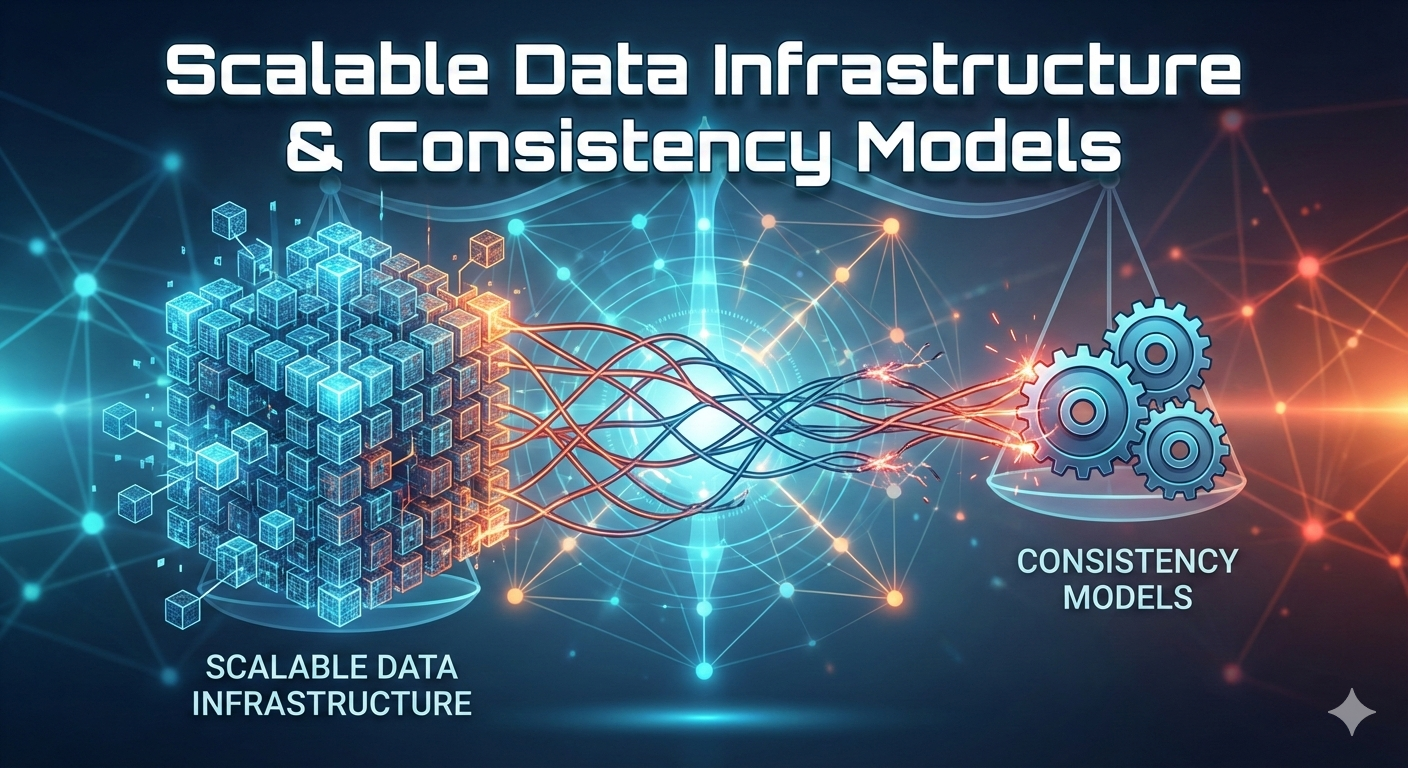
Most systems begin their lives with an implicit assumption: data is consistent because the database makes it so. Early architectures rely on defaults—single instances, synchronous writes, transactional guarantees—without consciously choosing a consistency model. At small scale, this works. At larger scale, it quietly fails.
As systems grow, data volume and traffic increase linearly or even exponentially. Teams add capacity, scale out infrastructure, and introduce replicas. Throughput improves. Storage grows cheaply. And yet, latency spikes, anomalies appear, and correctness becomes harder to reason about. The bottleneck is no longer compute or disk. It is coordination.
Consistency stops scaling at the same rate as data and traffic because consistency is fundamentally about agreement. Agreement requires coordination, and coordination is constrained by latency, failure, and contention. While storage can be partitioned and reads can be replicated, agreement cannot be parallelized without cost.
This is the moment when consistency transitions from being an invisible database feature to an explicit architectural concern. Choices that were once implicit now define system behavior under load and failure. Consistency becomes a growth constraint, not because databases are weak, but because correctness has a price.
At this point, treating consistency as an implementation detail becomes dangerous. It is no longer something that can be tuned away. It is an architectural commitment that shapes system limits, failure modes, and team behavior.
What “Scalable Data Infrastructure” Really Means
Scalable data infrastructure is often misunderstood as the ability to store more data or serve more queries. While necessary, those capabilities are insufficient to describe real scalability.